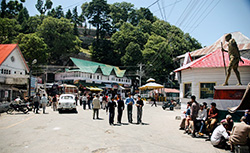
Gandhi Chownk (G.P.O
Unlike several other hill stations of Himachal Pradesh, Dalhousie is favourite among those who seek solitude and restfulness.The place is remarkably crime free.
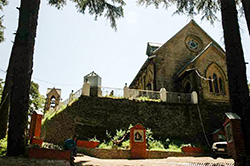
The greatest activity in Dalhousie is on and around the three level Malls which were laid in the early 1860s for promenades, carriages, horses, dandies, etc. these roads and the steeper by-lanes which connect them to the bus-stand are still the arteries of the town. The Malls around Moti Tibba and Potreyn hills are the most popular among the tourists as the two are level and most of the business activity and hotels are around them. Gandhi Chowk, Upper bazaar. Subhash chowk, Catholic church of St. Frances, Sadar bazaar and the Convent founded by an Order of Belgium nuns and their Sacred Heart School are on these two malls. Dalhousie’s third and highest mall was built around the upper Bakrota hill nearly a 1000 feet above the G.P.O. (Gandhi Chowk).

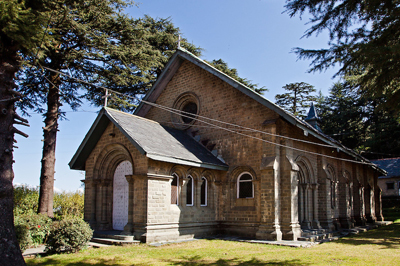
St Pauls Church
In 1851 a spot where the Dayan Kund Ridge breaks in to spurs was selected for the project and Kathalagh was identified for the construction of Convalescent Depot. Dr. Clemenger of the 49th Native infantry was deputed to make necessary observations on the site. In 1853 the five hills of Kathalagh, Potreyn, Terah, Bakrota and Bhangora were acquired

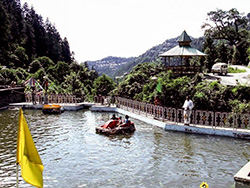
Dainkund Valley
State Bank of India has its ATM at Bus Stand. H.P State Cooperative Bank has started it ATM services at Gandhi Chownk & Punjab National Bank is starting its ATM service at Court Road Dalhousie shortly.
The Post Office is also located at the G.P.O. It remains open from 10a.m. to 5 p.m. Conversion of currency is possible at Punjab National Bank. The business hours in the Bank are from 10 a.m. to 2 p.m.
Dalhousie has one Civil Hospital managed by the H.P State Government, there are few chemist shops in Dalhousie, one is at G.P.O and two at Subash Chownk.
There are only a few travel agencies in Dalhousie and are not very efficient
Taxi services are provided by the Dalhousie Taxi Union having their offices at G.P.O, Subash Chownk & Bus Stand.
There are two world renowned Public Schools, Dalhousie Public School and Sacred Heart School.
Himachal Pradesh has become India’s most popular hill resort owing to its easy accessibility and diversity of hill stations which are known for cool and salubrious climes, seats of much worshipped religious deities and adventure sports. Dalhousie is one such hill station which is increasingly becoming popular among home and foreign tourists. Nestled on the spur at the western end of Dhauladhar, Dalhousie in its present shape was founded in 1850’s when the British acquired five hills from the ruler of the Chamba State for developing the area as a sanatorium. The project originated with Lt. Col. Napier, then Chief Engineer of Punjab; (‘afterwards Lord Napier of Magdala”).
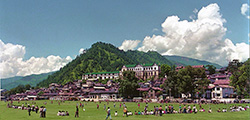
As Shimla finds its focus in the mall, in Dalhousie action gravitates in the evening to the G.P.O. which presents a riot of colours and activity. Sometimes it even becomes difficult to surge ahead without jostling and elbowing. Most of the good eateries and handicraft emporia, hotels and of course the ever attractive Tibetan market are all around the G.P.O. There is a library and a reading room at the G.P.O. for the convenience of the tourists.
Dalhousie has a number of period buildings. Most of them are occupied by state Government offices officials. Jandrighat, the summer palace of the Raja of Chamba is a well maintained edifice. There are a number of good public schools in Dalhousie. The best is the Sacred Heart School of the Belgium nuns. Besides there are another half a dozen schools which attract the wards of the affluent and well to do families from India and abroad.
Even during the pre-partition days, Dalhousie attracted large number of tourists. Some of the distinguished personalities like Ravinder Nath Tagore, Subhash chander Bose and Pt. Jawahar Lal Nehru visited Dalhousie in their formative period to immerse themselves in the leisurely quiet of this hill station. The calm and compose walks of the thick forests stirred the poet in Ravinder Nath Tagore. Some of his early poems are set against the backdrop of Dalhousie. Sardar Ajeet Singh, chacha of Sardar Bhagat Singh and a freedom fighter himself came to rest his tired limbs in Dalhousie and he breathed his last just before declaration of India’s Independence on 15th August, 1947. there is a samadhi in the memory of Sardar Ajit Singh at Panchpula which is a place frequented by every tourist.
Pt. Nehru visited Dalhousie in 1925 and Subhash Chander Bose convalesced in Kynance near the Post-Office for about seven months in 1937. Dalhousie Centenary Celebrations were held in August, 1954. Late Pt. Jawahar Lal Nehru, the then Prime Minister presiding over the occasion, drew the attention of government and people of India for rehabilitation of this beautiful hill station. He said,”One of the finest hill station in is Dalhousie from the beauty point of view, climate and agreeable surroundings. It is not a flashy hill station like some other and there are few amusements there… for my part, I would rather go to Dalhousie than almost any hill station in India, Kashmir apart…”